Mas Domnik as a Visitor
Dominica
Dominica Carnival from the Outside
You do not need a costume to feel Mas Domnik.
Of course, playing mas gives you the full road experience — the music around you, the movement of the band, the heat, the costume, the feeling of being inside the parade rather than beside it. But watching Dominica Carnival from the roadside offers something different.
You notice more.
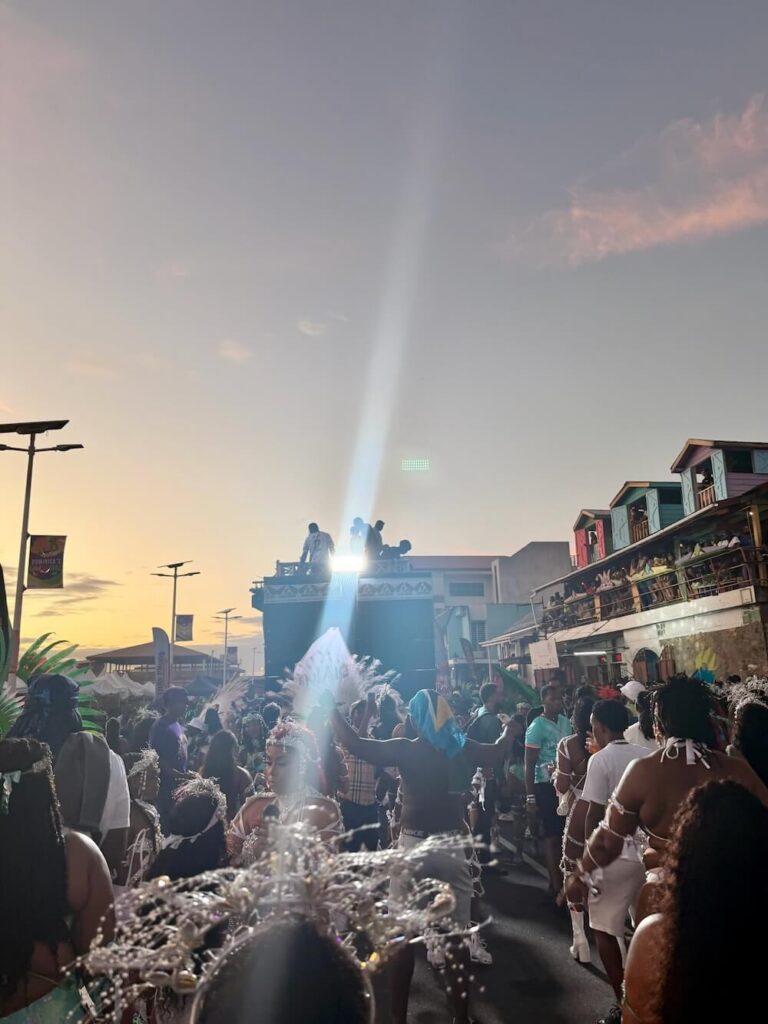
You see the traditional characters, the families waiting in the shade, the vendors moving through the crowd, the children in costume, the older people who know exactly when to smile, shout, comment or step aside. You see how Roseau changes during Carnival, not only as a parade route, but as a living city.
And in some ways, not playing mas gives you access to more of the Carnival calendar.
That freedom matters. It allows you to see Mas Domnik not only as a road experience, but as a cultural festival unfolding over several days.
Mas Domnik is not a Carnival that only happens behind ropes. It still feels close to the street. That is what makes it so interesting to watch.
Carnival Close to the Street
Mas Domnik is often called “The Real Mas”, and as a spectator you begin to understand why.
It is not the biggest Carnival in the Caribbean, and that is part of its appeal. In Roseau, Carnival still feels close enough to read. You can stand on the side of the road and notice the details: the way people react to a familiar rhythm, the way a traditional masquerader moves, the way the crowd opens and closes around the parade, the way children copy what they see from the adults.
There is a scale to Mas Domnik that makes watching rewarding. It is lively, but not so overwhelming that everything becomes a blur. You can see the mix of contemporary costume bands, T-shirt bands, traditional masquerade, families, musicians and spectators. The Carnival does not feel separated from daily life. It spills into the city, and Roseau becomes part of the performance.
That is especially valuable if this is your first time in Dominica. Watching gives you time to understand the rhythm of the festival before deciding whether you want to play mas yourself. You can observe the structure, the mood, the crowd, the music and the traditions without being tied to one band or one costume.
It is less immersive than jumping, but in some ways more revealing.

Best places to stay in Roseau for carnival
Comfort matters during Carnival, of course. But in Roseau, access matters more.
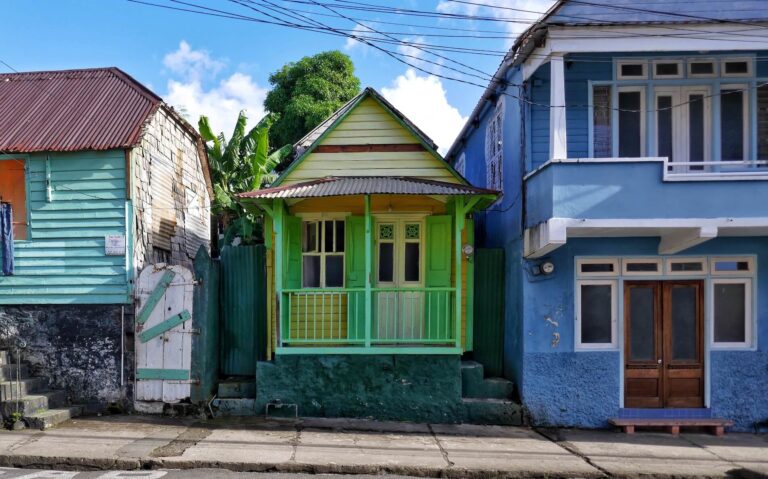
You do not need a resort-style escape as much as you need to be close to the action: the parade routes, the waterfront, the old streets, the food spots and the places where the city naturally gathers during Carnival week.
I would choose somewhere in or near the capital that lets you move with the rhythm of the day — step out for the road, return for a shower or a quiet hour, then head back out when the music starts again. During Mas Domnik, Roseau becomes the centre of everything. Staying close means you do not just arrive for the spectacle; you feel the city shift around you.
Why Watching Gives You a Broader View of Mas Domnik
There is a tendency to think that if you are not playing mas, you are missing the main experience. I do not think that is true.
Playing mas gives you intensity. Watching gives you range.
As a spectator, you can move more freely between events. You are not planning your day around makeup, costume collection, band meeting points, lunch stops, road routes, bathroom logistics or recovery time. You can wake up for one event, pause, return for another, follow the crowds, ask questions, and stay out for the parts of Carnival that are easier to miss when your entire focus is the road.
That matters in Dominica because Mas Domnik is not only about the final parade days. The full season includes pageants, calypso, bouyon, traditional events, children’s participation, J’ouvert, T-shirt bands, Carnival Monday, Carnival Tuesday and the Burning of the Vaval.
If you are curious about culture, watching may give you a wider understanding of the festival.
You see Carnival as a calendar, not just a costume.
Kiddies Carnival: Where Mas Domnik Feels Like a Community Festival
One of the best reasons to experience Mas Domnik as a spectator is that you can make time for the events around the main parade days. Kiddies Carnival is one of them.
This is where Mas Domnik starts to feel especially rooted in community. Instead of only seeing adults on the road in full costume, you see children, families, schools, parents, teachers and local groups taking part in the season. The costumes may be smaller, but the pride is not.
Kiddies Carnival reminds you that Carnival is something people grow up with. Children are not only watching from the sidewalk. They are already part of the tradition. They learn the music, the movement, the patience of waiting, the excitement of dressing up, the feeling of being seen by the crowd.
For me, events like this are important because they show Carnival beyond spectacle. They show continuity. Mas Domnik is not simply a party that appears for two days in Roseau. It is a cultural season that includes different generations, different forms of participation and different levels of performance.
If you only come for Carnival Monday and Tuesday, you may miss that softer, more local side. Kiddies Carnival gives you a glimpse into how Carnival culture is passed on — not through explanation, but through participation.
Carnival Monday: J’ouvert, Youth Mas and T-Shirt Bands
Carnival Monday is where you begin to understand that Mas Domnik is not one single parade. It changes throughout the day.
The morning starts early with J’ouvert, the pre-dawn opening of the street celebrations. This is the rawer side of Carnival: early hours, music, movement, people on the road before the full heat of the day. Even if you do not take part fully, witnessing J’ouvert gives you a sense of how Carnival wakes the city.
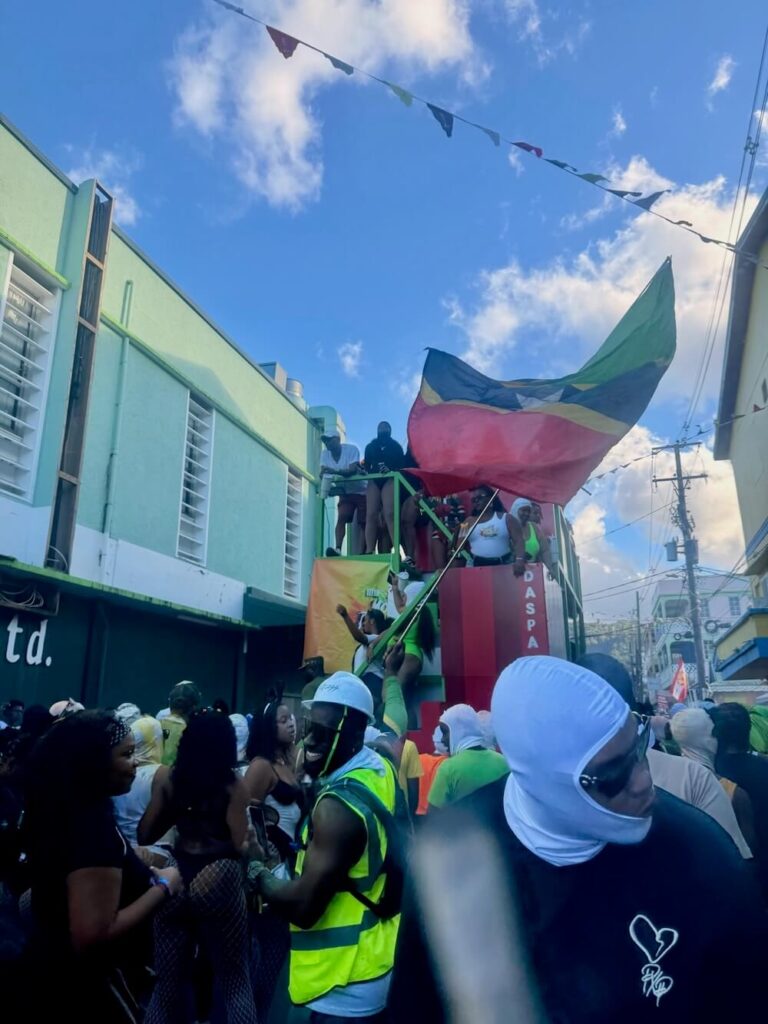
Later, the atmosphere shifts. Youth Mas, school bands and community participation bring another kind of energy into Roseau. Then the T-shirt bands take over the road, filling the streets with music, movement and a more casual version of masquerade.
That variety is what makes Monday so interesting to watch.
It does not feel like a single polished show. It feels like a city moving through different versions of Carnival: early-morning release, family participation, youth expression, then the road-party energy of the T-shirt bands.
If you are playing mas, this can be a lot to manage. You may need to rest, change, meet your band or save your energy for the road. As a spectator, you can move between these layers more easily. You can watch how the city changes during the day, rather than experiencing only one part of it.
That is one of the biggest advantages of watching Mas Domnik from the outside. You are not locked into one band or one route. You can follow the rhythm of the whole festival.
Carnival Tuesday: Traditional Mas and Costume Bands
Carnival Tuesday is the more visual day.
This is when the grand parade brings together contemporary costume bands, traditional masqueraders and competing groups moving through Roseau. If Monday feels like the city warming and loosening into Carnival, Tuesday feels more like the public showcase.
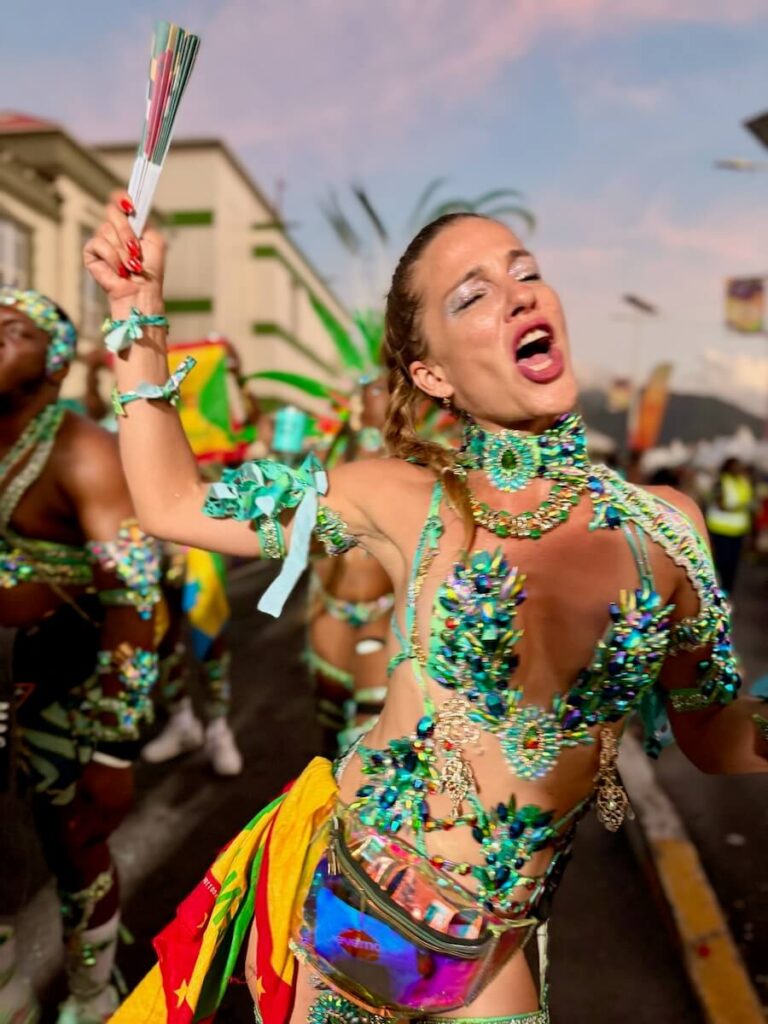
For many visitors, this is the day that looks most like the idea of Caribbean Carnival: colour, costumes, music, dancing, bands on the road. But in Dominica, the most interesting part is not only the modern costume bands. It is the mix.
You may see contemporary costumes, yes, but also traditional characters and older masquerade forms. You hear bouyon and calypso, but you may also notice drums, chants, commentary, humour and local references you may not fully understand at first.
That is part of the point.
Watching Carnival Tuesday is not only about recognising everything. It is about paying attention to what moves through the street. Modern mas and traditional mas do not cancel each other out here. They exist side by side, sometimes in contrast, sometimes in conversation.
As a spectator, you have the space to notice that.
What to Look For When Watching Mas Domnik
If you watch Mas Domnik only for the costumes, you will miss half of what is happening.
Look for the older masquerade forms. Listen for the drums. Notice how people on the sidewalk respond. Watch how the parade interacts with the city rather than simply passing through it.
Some of the most interesting moments are not the most obvious ones. A child copying a dance move. A woman leaning out from a doorway to watch the road. A vendor moving through the crowd. A group of elders reacting to a familiar character. A masquerader pausing just long enough to tease the crowd.
This is where watching becomes its own experience.
You are not inside the band, but you are reading the street. You begin to understand that Carnival is not only what happens in the middle of the road. It is also what happens around it: the commentary, the laughter, the waiting, the recognition, the small exchanges between performers and spectators.
Traditional mas is especially worth watching closely. Do not treat it as something strange or decorative. These characters carry history, humour, memory and social meaning. Even when you do not understand every reference, you can still recognise that you are seeing more than costume.
Mas Domnik rewards attention.
Where to Watch Mas Domnik in Roseau
Roseau is the centre of Mas Domnik, and its compact size makes Carnival relatively easy to experience as a spectator.
The best place to watch depends on the official route, the day and the type of event, so always check locally once you arrive. Your hotel, driver, guide or local contacts may have more useful information than a map. Carnival routes and timing can feel fluid, and local knowledge helps.
In general, look for a spot where you can stand safely, see the road and move if you need to. Shade matters more than you might think. Carnival days are long, hot and loud, and the perfect viewing spot is not always the one closest to the action.
Try not to block residents, families, vendors or official access points. Roseau may become a Carnival stage during Mas Domnik, but it is still a city where people live and work. The best way to watch is to stay flexible. Move when you need to. Step back when the road fills. Let bands pass. Follow the energy without forcing your way into it.
If you are staying close to the route, that is a big advantage. You can dip in and out, rest when needed and return later. If you are staying outside Roseau, plan your transport in advance, especially at night or after major events.
What to Wear as a Spectator
Dress for heat, standing and sudden movement.
You do not need anything fancy to watch Mas Domnik. In fact, simple and comfortable is better. Wear light clothing, comfortable shoes and sun protection. A hat and sunglasses can make a big difference, especially if you are outside for several hours.
I would keep your bag small and secure. A crossbody bag or small backpack works better than anything bulky. Bring water, some cash, tissues or wipes, and a portable charger if you are using your phone for photos and videos.
If you plan to watch J’ouvert or stand close to very active parts of the crowd, a waterproof phone pouch is useful. Carnival can be sweaty, crowded and unpredictable, and it is better not to carry anything you would be upset to damage.
Most importantly, wear shoes you can actually stand and walk in. Carnival looks glamorous in photos, but watching it properly often means hours on your feet.
Safety, Comfort and Common Sense
Watching Mas Domnik felt accessible, but like any street festival, it helps to use common sense.
Keep valuables minimal. Stay aware in crowds. Avoid standing in the road when bands are moving. If the music trucks, masqueraders or groups are coming through, give them space. Do not assume you can always cross quickly.
Hydrate more than you think you need to. Take breaks. Find shade. Eat something proper during the day, especially if you plan to stay out for several events. If you are drinking, pace yourself. The heat and long hours can catch up with you quickly.
If you are visiting alone or staying outside the centre, arrange your transport back before the night gets too late. Carnival is more enjoyable when you are not trying to solve logistics at the end of a long day.
None of this should make Mas Domnik sound difficult. It is simply a reminder that the best Carnival experiences often come from being prepared enough to stay relaxed.
Photography Tips for Mas Domnik
Mas Domnik is incredibly photogenic, but the best photos are not always the most obvious ones.
Yes, the costumes are beautiful. Yes, the colour and movement are tempting. But the small moments often tell the better story: someone adjusting a headpiece, a drummer’s hand, children watching from the curb, a vendor passing through the crowd, a quiet street just before the parade arrives.
Wide street shots are usually easier and less intrusive. If you want close portraits, ask first. This is especially important with children, traditional masqueraders and anyone who is not clearly posing for the crowd.
Do not block the road for a photo. Do not push in front of people who have been waiting. Do not treat participants as props. Carnival is public, but that does not mean every face is yours to capture closely.
If you are creating content, think about the story your images tell. Mas Domnik is not only feathers and costumes. Photograph the context too: the buildings, the crowd, the vendors, the waiting, the road, the hands, the music, the heat.
That is where the atmosphere lives.
How to Experience Mas Domnik Respectfully
Mas Domnik is welcoming, but it is not yours to consume carelessly.
Watch with curiosity. Support local vendors. Ask before taking close photos. Learn the names of what you are seeing. If you do not understand a character, a sound or a tradition, ask respectfully or read more afterwards.
Be especially mindful with traditional mas. Do not describe it as weird, scary, primitive or exotic. Those words flatten cultural expression into stereotype. Traditional characters may be playful, intense, satirical, humorous or visually striking, but they are not random costumes. They belong to a wider Carnival history.
The same applies to social media. It is easy to post the most dramatic image with a careless caption. Take a little more time. Mas Domnik deserves better than that.
As a visitor, your role is simple: enjoy the atmosphere, but remember that you are entering someone else’s cultural space. Be present, be generous, be observant, and do not make yourself the centre of everything.
Practical Travel Tips for Roseau

Plan your Dominica Itinerary
Waterfalls, rainforest, hot springs and volcanic coastlines — Dominica is wild by nature.
-
Visiting Kalinago Barana Auté
Voices of Dominica’s First People Dominica is often described through its landscapes first. Rainforest. Rivers. Waterfalls. Hot springs. Volcanic peaks. Roads that twist through the mountains before opening suddenly to the Atlantic. It is an island that feels physical from the moment you arrive — green, humid, steep, alive. And yet, if you only come…
-
Roseau, Dominica: What to See in the Island’s Colorful Capital
Roseau Beyond the Waterfront Roseau is small, colourful, busy and a little rough around the edges. It is not the kind of Caribbean capital that feels polished for visitors — except perhaps around the waterfront, where the city briefly becomes more arranged for cruise arrivals. Beyond that first layer, Roseau feels much more local. You…
-
How to play mas in Dominica
Costumes, Culture and Mas There is a moment when Carnival stops being something you watch and becomes something you feel in your body. For me, that moment came on the road with Hysteria Mas in Dominica. The music was already moving ahead of us, the streets of Roseau were filling with people, and suddenly I…
-
Bouyon Music in Dominica: The Soundtrack of Mas Domnik
The Soundtrack of Mas Domnik Bouyon does not politely stay in the background. It pushes forward. It repeats. It builds pressure. It gets into your body before you have fully understood what you are hearing. During Mas Domnik, Dominica’s Carnival, bouyon is everywhere: on the road, at parties, during J’ouvert, from trucks, passing cars, street…
-
Soufrière and Southern Dominica: A Guide to the Island’s Volcanic Coast
Where the Island Turns Volcanic After the intensity of Mas Domnik in Roseau, southern Dominica felt like a different island. The capital had been all music, movement and Carnival rhythm. Bouyon in the streets. Costumes on the road. People watching from balconies. The same corners appearing again and again as we circled Roseau during Carnival….
-
Beaches in Dominica
Dominica’s Beaches, Without the Caribbean Filter Dominica is not the island I would recommend if your idea of the Caribbean is a week of white sand, beach loungers and polished resort beaches. And that is not criticism. Dominica is the Nature Island of the Caribbean for a reason. Its strongest landscapes are rainforest, rivers, waterfalls,…