Chefchaouen
Morocco
Beyond the Blue
Many travelers have been enthused by the charm of Morocco’s blue city: Chefchaouen. So, of course, we were eager to discover the blue town for ourselves. After getting a CTM bus ticket, we were off to the Rif mountains. As soon as we arrived at the bus station, we were a little surprised: at least from the first expression, the city didn’t seem to be blue. As soon as we entered the medina, and eventually our Dar, we had to revoke our first impression: Literally, everything seemed to be blue in the old medina. It almost seemed unreal. Chefchaouen, “Morocco’s prettiest medina,” is relaxed compared to other medinas making it easy to explore.
Chefchaouen is quite a lively town. The medina’s alleys are plastered with souvenir stands and other Morrocan crafts. It seemed a little overwhelming, and we wish there were a bit more authenticity left. Yet the salespeople were almost shy compared to Fez, so one could stroll the streets without being stopped at every corner. As soon as you wander off the main alleys, you’ll be surprised to find beautifully hidden plazas, fountains our buildings.
Not only is Chefchouen geographically close to Spain, but the Spanish have colonized the town. Hence, almost everyone spoke Spanish, making it a lot easier for us actually to engage in a conversation.

Best places to stay in Chefchaouen
Chefchaouen is not a place where you need a grand hotel. The town is at its best when you stay close to the medina, somewhere small enough to feel personal and rooted enough to reflect the mountain setting. I would look for places that keep you within walking distance of the blue lanes, but still give you a quiet terrace, local hospitality and a sense of northern Morocco beyond the photographs.
Riad Cherifa is one of the more atmospheric places to stay in Chefchaouen if you want the classic riad feeling without losing the town’s softer character. It has the tiled courtyards, carved details and calm interior spaces you hope for in Morocco, but still feels intimate enough for a small mountain town.
Casa Perleta is a charming choice for travelers who want something warm, simple and well placed inside the old town. It has more of a guesthouse feeling than a polished hotel, which suits Chefchaouen well. I would recommend it if you want to stay close to the medina’s blue lanes and experience the town at a slower pace.
The more classic Marrakech choice: intimate, quiet and close to Jemaa el-Fna, but with a stated sustainability policy around local suppliers, eco cleaning products, water and energy use.
For something more nature-led, Gîte Talassemtane is the most interesting option. Located outside Chefchaouen near Talassemtane National Park, it offers a different way to experience the region — less blue-city postcard, more Rif Mountains, hiking, villages and ecotourism. It is a good fit if you want your stay to connect more directly with the landscape around Chefchaouen. Its own site describes it as an eco-lodge about 12 km from town, focused on discovering the natural and cultural heritage of the region.
Why is Chefchaouen blue?
No one seems to agree entirely on why Chefchaouen’s medina is painted blue, and that uncertainty has become part of the town’s mythology. Some say the color was introduced by Jewish communities who settled here and associated blue with the sky and the divine. Others connect it more practically to keeping houses cool, repelling insects, or simply continuing a local tradition that grew stronger over time. Whatever the exact origin, the blue now shapes the way Chefchaouen is seen and remembered — not just as decoration, but as an atmosphere that softens the medina and gives the town its unmistakable identity.
Wander Through the Medina
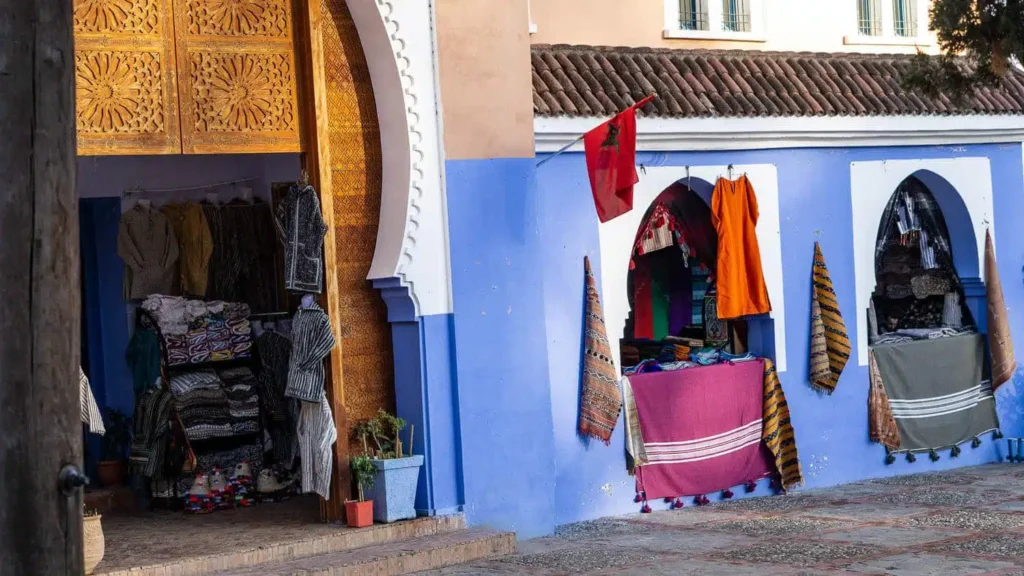
Chefchaouen’s medina is small enough to wander without much of a plan, and that is exactly how I liked it most. At first, it is the blue that pulls you in — the painted steps, doors, walls and alleyways that seem almost too beautiful to be real. But after a while, other details begin to stand out: the mountain air, the slower pace, the cats stretched out in patches of sun, the women carrying bread, the small shops selling woven blankets, leather slippers and woollen djellabas.
What surprised me was how different it felt from other Moroccan medinas. Chefchaouen has a softer, almost Andalusian atmosphere — less dense, less hectic, and somehow more Mediterranean in feeling. The whitewashed walls, blue paint, tiled details and mountain setting made it feel closer to southern Spain at times, which makes sense given the town’s history and the movement of Muslim and Jewish communities from Andalusia into northern Morocco. It is still very much Moroccan, but with a northern character that feels distinct from Marrakech, Fes or Meknes.
The best thing to do is simply walk. Let the main lanes lead you toward the busier corners, then drift away into quieter streets where the town feels less like a photo backdrop and more like a place people actually live. Chefchaouen is beautiful in pictures, but the medina makes more sense when you slow down enough to feel its rhythm.
Hike the Rif Mountains
Just beyond Chefchaouen’s blue lanes, the Rif Mountains begin to take over. Talassemtane National Park is the wilder side of the town — a landscape of limestone cliffs, river valleys, mountain paths and small Amazigh villages where the rhythm feels very different from the medina below.
This is where Chefchaouen starts to make more sense. The town is not only a pretty blue stop on a Morocco itinerary; it sits at the edge of a much larger mountain world. Trails lead toward waterfalls, viewpoints and rural settlements, with Akchour being the best-known excursion for travelers who want a full day in nature.
The Rif also has another, more complicated layer. This region has long been associated with kif and hashish production, something woven into its rural economy and often mentioned by locals. It is part of the reality of the mountains, but not something to treat lightly or romanticize. As a traveler, it is better approached as context rather than as an attraction.
Go for the landscapes, the walking, the mountain air and the chance to understand Chefchaouen beyond its color. Hire a local guide if you want to go deeper into the park, support small cafés or family-run places along the way, and remember that these mountains are not just scenery — they are home, livelihood and history.
Take a Day Trip to Akchour
For a full day outside Chefchaouen, Akchour is the easiest and most rewarding nature escape. The village sits about a short drive from town and is usually reached by taxi, private driver or shared transport arranged locally. From there, the landscape changes quickly: blue lanes give way to a river valley, rocky paths, natural pools and waterfalls tucked into the mountains.
The main walk to the waterfall is not something I would treat as a quick stop between sights. It is better as a slow half-day or full-day outing, especially if you want to pause for mint tea, cool your feet in the water, swim in warmer months or take your time along the valley. Wear proper shoes, bring water and go early, before the day becomes too hot or too busy.
Akchour is popular, but it still gives you a different sense of northern Morocco — more open, more rural, and much closer to the landscape that surrounds Chefchaouen.
Climb to the Spanish Mosque for Sunset
One of the simplest and most beautiful things to do in Chefchaouen is the walk up to the Spanish Mosque before sunset. The path starts at the edge of the medina and slowly lifts you above the blue-painted streets, until the whole town appears below you with the Rif Mountains rising behind it. It is the classic Chefchaouen view, but it is worth experiencing slowly. Go a little before sunset, bring water, and give yourself time to sit for a while. The best part is not only the photo, but watching the light change over the town as the call to prayer drifts up from below.
Treat yourself to a hammam visit
If you are planning on spending more time and actual time unwinding, check into a hammam. We have written about hammams in Fez and Marrakesh. Hammams are a must-do in Morocco! Chefchaouen offers several hammam options, primarily catering to tourists. The treatments offered looked super tempting!
Popular Tours around Chefchaouen
Practical Travel Tips for Chefchaouen


Traveling Morocco?
Places to visit in Morocco
Live the dream of 1001 nights!
-
Marrakesh | Live dream of 1001 nights
A Love Letter to the Beautiful Madness of Marrakech Marrakesh mesmerized me from the first second. Immediately we were surrounded by “guides” eager to lead us to our Riad. We would have never found our Riad, even though the taxi left us only about 300 m from the entrance. The unimposing door was hiding a…
-
Meknès | Authentic vibes between beauty and roughness
A Medina Without the Performance Meknès is not as often visited as its glamorous neighbor Fez. We really can’t understand why. To us, Meknès was a fascinating city to see because it allowed for more authentic impressions of Morocco. It’s not as busy or big as its famous neighbor Meknes, but that only adds to…
-
Fez, Morocco | The world’s biggest maze
The world’s most extensive maze Until today, the medina of Fez is the largest car-free zone in the world. Fez’s old city, the medina, consists of more than 9400 alleys. Some of them are more extensive; some so narrow you almost don’t recognize them as a path. Moroccans are proud of their traditions and heritage….